London-based Skyral has closed a $20 million Series A funding round led by European venture capital firm NOIA Capital, with participation from Accrete Capital, as the company looks to accelerate the global deployment of its AI-enabled digital twin technology.
Founded in June 2023, Skyral has rapidly established itself as a leader in strategic modelling and simulation software, creating digital twins that model human behaviours alongside real-time infrastructure systems including transit, power, and telecommunications networks of entire cities and countries.
The funding will support research and development, global team expansion, and accelerated solution delivery across Skyral’s core sectors of defence, national security, healthcare, and infrastructure.
Proven Track Record Across Sectors
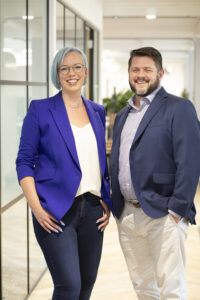
Led jointly by co-founders and executive directors Jason Kennedy and Naomi Hulme, Skyral has built a strong commercial foundation working with UK, US, and NATO partners whilst successfully diversifying its client base. Over 60 percent of the company’s contracts now come from both public and private sectors.
Nick Blair, co-founder and Chairman of Skyral, said:
“This investment is a strong endorsement of both Skyral’s technology and its ability to solve complex global challenges, as well as the excellence of UK innovation.
“Our digital twin software is at the forefront of a new era in decision-making, where virtual models power real-world transformation. With the backing of NOIA and our other investors, we are well-positioned to scale faster, deepen the capabilities of our platform, and deliver greater value to our customers worldwide.”
The company’s technology has demonstrated significant real-world impact across multiple domains. Skyral helped shape requirements for the Collective Training Transformation Programme during a pathfinder with the British Army and has been downselected as part of the Omnia Training consortium alongside major defence contractors Raytheon, Rheinmetall, Capita, and Cervus.
In civilian applications, Skyral’s digital twins tackled complex public health challenges, including modelling COVID scenarios for the UK government during the pandemic and identifying clinical and policy pathways to reduce child stunting in Indonesia over 50 times faster than conventional methods.
Technology at the Forefront of AI Innovation
Skyral operates in the rapidly expanding modelling and simulation software market, combining data visualisation, artificial intelligence, and digital twin capabilities to provide comprehensive insights for decision-makers across various industries.
The company’s platform integrates behavioural data with real-time infrastructure systems and predictive modelling to create strategic digital twins that enable governments and businesses to experiment virtually before making critical real-world decisions.
Jérôme Lhoist, partner at NOIA Capital, said:
“We believe Skyral represents the next generation of AI-enabled strategic modelling and simulation technology. Their unique combination of digital twin capabilities and AI-powered analytics offers transformative potential across defence, national security, healthcare and infrastructure. We’re excited to support their vision and help scale their impact globally.”
Scaling for Global Expansion
With over $100 million already invested in research and development, Skyral’s software-driven approach and cross-sector partnerships have led to rapid market adoption across its target sectors globally.
The company intends to use the new capital to expand its team, accelerate product development, and strengthen its position in key markets across Europe, North America, and Asia.
The funding round represents a significant milestone for the two-year-old company as global demand for predictive simulation and digital twin technology accelerates, driven by geopolitical instability, climate risk, and the increasing complexity of infrastructure and logistics networks.